


Fast Facts:
Program: B.A. Sociology and B.A. Religious Studies
CSUF Achievement: Magna Cum Laude and Mellon Mays Undergraduate Fellow
Current Program: M.A. Theology, Loyola Marymount University
Future Goal: Pursue doctoral studies in Historical Theology and teach at the university level
Tell us a little about yourself and your academic journey.
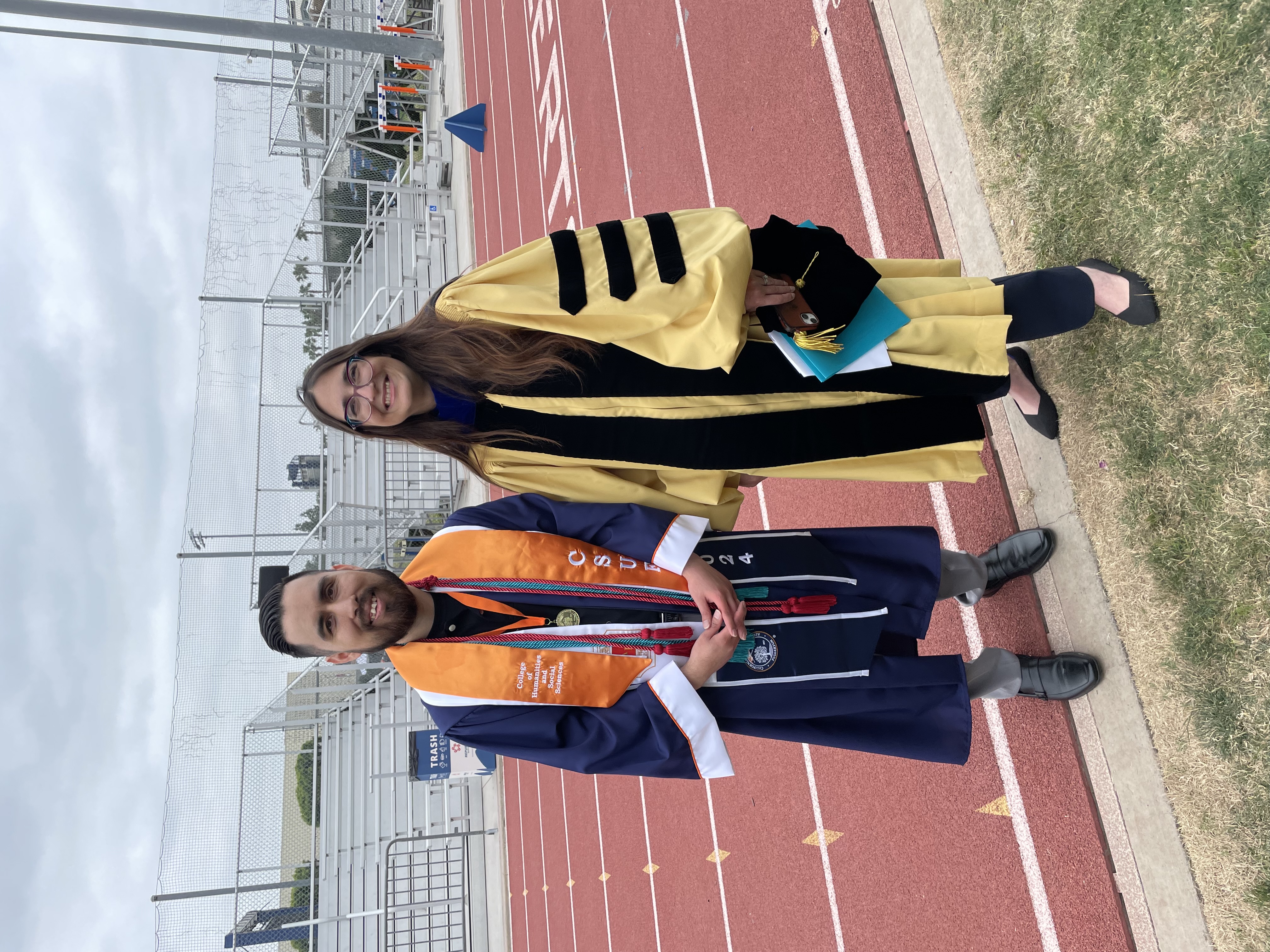 My name is Mario Benitez, and I am from Anaheim, California, where I have lived my entire life. My academic journey has been anything but traditional, but it is a path that has shaped who I am and one that I would not change.
I am a first-generation college student, an adult reentry student, a parent, and a DSS student living with a panic disorder. Each of these experiences has influenced the way I approach education and has given me a deep appreciation for the opportunities that higher education can provide. Becoming a parent at a young age played a significant role in my decision to step away from school for several years. When I eventually returned to higher education as an adult, I did so with a renewed sense of purpose and a much clearer understanding of what I hoped to accomplish.
I began my academic journey at Santa Ana College, where I earned multiple associate degrees before transferring to California State University, Fullerton. I initially planned to major in Sociology, but after being awarded the Mellon Mays Undergraduate Fellowship and taking several Religious Studies courses, I discovered a passion for the academic study of religion and decided to complete a double major in Sociology and Religious Studies.
Although Sociology and Religious Studies approach different questions, I found that they complemented one another in helping me better understand the human experience. Sociology provided tools for examining social structures, inequality, and the forces that shape communities, while Religious Studies allowed me to explore the beliefs, traditions, and historical developments that continue to influence societies around the world. Together, these fields challenged me to think critically about culture, justice, history, and meaning.
My time at CSUF was also shaped by my involvement with the Transfer, Adult Re-entry, Parenting, and Pregnant Student Center (TAPP Center), where I later served as a student assistant. That experience helped me develop a stronger sense of identity as a transfer and adult reentry student, and it deepened my commitment to supporting students whose educational journeys do not always follow a traditional path.
I graduated from CSUF magna cum laude and am currently entering the final year of my M.A. in Theology at Loyola Marymount University, where I serve as a Graduate Assistant. My academic interests center on historical theology and the theology of the early Church.
As I look toward the future, I am considering pursuing doctoral studies in Historical Theology and continuing to contribute to the academic study of religion, history, and society.
Why HSS? What drew you to the humanities and social sciences?
I was drawn to the humanities and social sciences because they teach us how to think, not simply what to think. These disciplines challenge us to ask deeper questions about people, cultures, history, institutions, and the forces that shape our world. More importantly, they encourage us to approach those questions with both critical thinking and empathy.
One of the greatest lessons I learned through HSS is the importance of examining our own assumptions. Whether we are discussing religion, culture, politics, or social issues, it is easy to speak confidently about topics we may not fully understand. The humanities and social sciences taught me to be more reflective, to ask better questions, and to engage perspectives different from my own with greater humility and respect.
In an increasingly polarized world, I believe these skills are more important than ever. HSS helps cultivate dialogue across differences by encouraging us to understand not only what people believe, but also why they believe it. Through studying history, religion, society, and culture, we begin to see the complexity of the human experience and recognize the dignity of people whose backgrounds and perspectives may differ from our own. Even when disagreements remain, meaningful dialogue becomes possible.
Ultimately, HSS felt like the perfect home for the questions that mattered most to me. It brought together my curiosity, my commitment to service, and my desire to better understand both individuals and communities.
Was there a class, professor, research project, internship, or experience that had a major impact on you?
If I had to identify one person who had a major impact on my academic journey, it would be Dr. Levesque from the Department of Religious Studies.
While I learned a tremendous amount from his courses, what made the greatest impression on me was not simply the content he taught, but the kind of educator and mentor he was. Dr. Levesque challenged me to think more critically, engage ideas with greater nuance, and examine assumptions that I had previously taken for granted. He encouraged intellectual curiosity while also creating an environment where students felt supported and respected.
As an adult reentry student, having a professor who believed in my potential made a significant difference. Whether through classroom discussions, office hours, or conversations about my future goals, Dr. Levesque consistently invested in my growth as both a student and a person. He encouraged me to pursue a double major in Sociology and Religious Studies and later supported my aspirations of attending graduate school and potentially pursuing a Ph.D.
Even today, I remain in contact with him, and I continue to value his guidance as I think about the next stages of my academic journey. His mentorship taught me that teaching is not simply about transmitting information; it is about helping students discover their own potential and cultivating a genuine love of learning.
If I eventually become a professor, which is my long-term goal, I hope to embody many of the qualities that Dr. Levesque demonstrated throughout my time at CSUF.
What are you doing now, and what are your future plans?
Currently, I am entering the final year of my M.A. in Theology at Loyola Marymount University, where I also serve as a Graduate Assistant in the Department of Theology. My graduate studies have allowed me to further develop my interests in historical theology, comparative theology, and the ways religious traditions engage contemporary social and ethical questions.
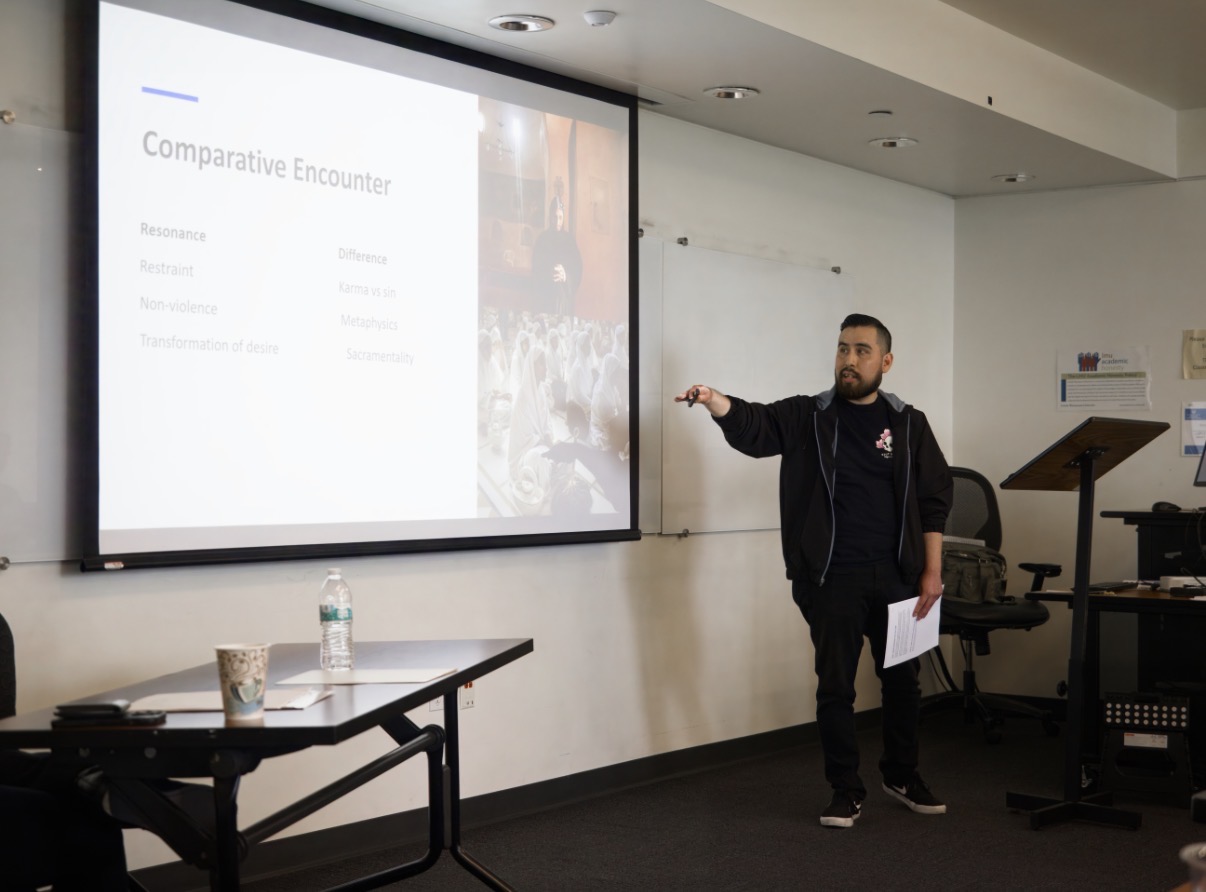
During my time at LMU, I was honored to receive both the Haciendo Caminos Fellowship and the Frederick Douglass Comparative Theology Fellowship. Through the Comparative Theology Fellowship, I conducted research examining themes of asceticism and environmental responsibility within both Jain and Catholic traditions.
Looking toward the future, I am considering pursuing a Ph.D. in Historical Theology after completing my master's degree. My long-term goal is to teach at the university level and contribute to the academic study of theology, history, and religion.
For now, I remain focused on completing my master's degree, continuing to grow as a scholar, and exploring ways to use education, research, and service to contribute meaningfully to both the academy and the broader community.
What accomplishment are you most proud of during your time at CSUF?
If I had to identify the accomplishment I am most proud of during my time at CSUF, it would simply be reaching the finish line.
I could point to graduating magna cum laude, completing a double major in Sociology and Religious Studies, being selected as a Mellon Mays Undergraduate Fellow, serving in the TAPP Center, or the honors and recognitions I received along the way. I am deeply grateful for each of those accomplishments, but when I reflect on my journey, they are not what stand out most to me.
What means the most is earning my degree and proving to myself that I could accomplish something I once believed was beyond my reach.
As a first-generation college student, adult reentry student, parent, and DSS student, returning to higher education was a significant leap of faith. There were many moments when pursuing a college degree felt unlikely, and there was certainly a time in my life when I never imagined I would attend a university, let alone graduate with honors and continue on to graduate school.
Reaching that finish line represents years of perseverance, growth, and support from countless people who believed in me.
What makes this accomplishment especially meaningful is that it serves as a reminder that educational journeys do not have to follow a traditional path. No matter where someone starts, how long they have been away from school, or what obstacles they face, it is possible to return, succeed, and excel.
What advice would you give to current or future HSS students?
If I could offer one piece of advice to current or future HSS students, it would be this: do not be afraid to ask questions.
One of the most valuable lessons I learned during my academic journey is simple: curiosity is a strength, not a weakness. Many students hesitate to ask questions because they worry that their question may sound uninformed or simplistic. In reality, the only question that goes unanswered is the one that is never asked. The humanities and social sciences are built upon inquiry, and some of the most meaningful learning begins with a simple question.
I would also encourage students to take advantage of office hours and build relationships with their professors. Some of the most impactful moments of my academic journey happened outside the classroom through conversations with professors who challenged, encouraged, and supported me.
Another important lesson is to use the resources available to you. Whether it is academic support services, student organizations, counseling resources, or centers such as the TAPP Center, there are people on campus who want to help you succeed. Seeking support is not a sign of weakness; it is often one of the smartest decisions a student can make.
I would also encourage students not to compare their journey to anyone else's. Every student arrives with different experiences, responsibilities, challenges, and opportunities. Your path is your own. Focus on your growth, celebrate your accomplishments, and remember that success does not have to look the same for everyone.
Finally, I want students to know that it is never too late to pursue higher education. As an adult reentry student, I returned to school later than many of my peers, and today I am completing a master's degree and considering doctoral studies. If there is one thing my journey has taught me, it is that there is no single timeline for success.
Take the chance, trust the process, and believe that you are capable of more than you may realize.