Transcript
How Should AI Be Regulated? With Dr. David Adams
AI is changing how governments operate, but who decides the rules? In this episode, Dr. David Adams from Cal State Fullerton’s Division of Politics, Administration, and Justice explores AI regulation, accountability, and how public agencies are using AI to make decisions that affect our communities.
This transcript was created using speech recognition software. While it has been reviewed by human transcribers, it may contain errors. Please review the episode audio before quoting from this transcript and email hssdeansoffice@fullerton.edu with any questions.
Jessica Stern
Hello, everyone. If there’s something we’re talking about more than anything else, it is artificial intelligence.
I think nationwide, the two major questions looming large are: What should the United States and local communities be doing to regulate artificial intelligence? And what do we do about data centers?
Data centers seem to be uniting people across the parties in opposition to them.
We are so lucky on this campus because we have in our midst Professor David Adams, who also runs our Public Administration program. We’re here to talk about these topics with Dr. Adams.
Welcome.
David Adams
Thank you very much. I’m excited to talk about them.
Jessica Stern
Let’s start by grounding you and your research. What do you do?
David Adams
My research focuses on one broad question: How do institutions adapt and sustain legitimacy in times of economic, political, environmental and technological uncertainty?
What that really means is I study what happens after the law passes.
When we think about public administration, we think about the laws passed by Congress. Once those laws are passed and everybody goes home after the bill is signed and made into law, somebody has to carry it out.
Policy is really what happens at the counter on a Tuesday in some city government office.
Jessica Stern
And you’re particularly interested in city government.
David Adams
I think most of the focus of my teaching is at the city-government level because a lot of our grad students are working in local government.
That’s where it’s really fun, too. The national government is one big complicated entity, but we have nearly 80,000 governments in the United States. There’s all of this variation among cities, counties, townships, school districts and water districts. They all have their own particular style.
Jessica Stern
What are some of the major decisions public agencies have to make when it comes to AI?
David Adams
I think it goes down to the biggest decision any public agency or public administrator has to make, and that’s around discretion.
The policies are written, but whatever is in that legislation, the real policy happens when the person actually implements it — whether it’s the caseworker in their office or the teacher in the classroom.
That’s where the policy is made. We consider that administrative discretion.
That person, that “street-level bureaucrat,” as Michael Lipsky defined it in the 1980s, is really where the policy happens.
When it comes to AI, are we turning some of those decisions over to an algorithm, to some sort of artificial intelligence? Is this artificial discretion?
That could be a good thing. You could have consistency in the decisions that are made.
But then, at the one point where the government interacts with the public, are we taking the human out of the equation — the human who can say, “Is this different?”
Jessica Stern
I think that’s the real stake.
We could be talking about two different things, right? There’s the use of AI by public agencies, and then there’s public agencies regulating how the community can use AI.
Let’s talk about the first one: the use of AI in public agencies.
Last year, we brought Allison Pugh out. She’s a sociologist who talks about AI. One of the major arguments she makes is that we’re all so stretched thin — in government, in health care, in teaching — that AI becomes a place where, instead of properly resourcing something, you turn to AI to get something done.
I could see this being a real lure in how cities and other government agencies run. Are they toying with how to use it themselves?
David Adams
Yeah, I think so.
The bigger public-administration question is: How do we hold it accountable?
If AI is making a decision, if we are putting it out there to help us make a task quicker or streamline a decision, where’s the back-end accountability?
Is it with a human who actually uses it?
When we put a human in place and say we have somebody monitoring what the AI is doing, are they really just sitting there hitting “yes” a thousand times a day to allow it to do whatever it’s doing?
Or are they catching it? Are they identifying when errors are made? If those errors are made, is there support for that employee to go back and adjust what the system has decided?
Jessica Stern
For people who are very far from city government, who may not even know they’re interacting with city government, what are some of the tasks a governmental entity could use AI for where they do have to make these decisions?
David Adams
A number of local governments and even some states have turned welfare benefits over to AI and algorithms.
It monitors compliance of the recipients — whether they’re meeting whatever standard they have to meet to continue receiving those benefits.
That’s a really big thing.
If you’re turning that over to AI to make those decisions, you may be taking the human out of the loop who might realize, like I said earlier, “This person is different,” or, “This situation is different.”
Virginia Eubanks wrote a book about inequality and the use of algorithms, and she highlights a few different cases.
One of them is Indiana, which turned its social benefits over to an algorithm to determine compliance. Once it got access to the information, it rolled off about a million recipients.
One of those cases involved an elderly woman in hospice care who missed a telephone appointment. The AI recognized that she missed the appointment and said, “She is out of conformance,” and her benefits were canceled.
I think that’s a real danger of turning over some decision-making to artificial intelligence or an algorithm when it can’t really judge what the circumstance is.
Jessica Stern
Right. It just sees zeros and ones. If you didn’t answer the telephone, you turn into a zero, and that can change your entire life.
Is that where this question you brought up before — how much is there a human monitoring these decisions — comes in?
David Adams
Yeah, I think so.
How much is there a human monitoring it?
And once an agency actually purchases and begins using this, especially a small local government, do they have somebody who actually knows what’s going on?
Can they evaluate its effectiveness? Can they evaluate how well it’s actually working?
Usually, it’s really easy to make the decision: Are we going to buy, or are we going to create our own AI?
Most folks decide to buy.
They decide, “Okay, we’ll purchase whatever platform from whatever company and install it into our systems.” That’s a huge purchase.
Then they tell the employees to go ahead and use it.
What they haven’t funded, or typically don’t fund, is the evaluation mechanism.
Can we go back and actually look: Is this meeting its needs? Is it making the right decisions? Is it doing better than we could do as a person on the same task?
That’s a whole separate budget conversation from the actual purchasing of the software.
Jessica Stern
Is there anything that’s out of bounds? Are there federal laws or state laws that say you cannot use it for X?
At Cal State Fullerton, for example, there is a rule that we cannot use AI for personnel actions.
Is there anything like that?
David Adams
Not broadly in the United States. It depends by state.
There are a lot of different AI laws across the states.
The federal government has tried to create one kind of blanket AI policy in a few different ways, and it has failed each time.
They tried to put it in the budget reconciliation bill, and it failed in the Senate 99 to 1.
Jessica Stern
What was that going to say?
David Adams
It was going to create a blanket AI policy that applied across the states to have some sort of unifying standard, preempting states from creating their own.
That would be good for the industry because it wouldn’t have to comply with 50 different policies. It would have one blanket national policy.
But again, in the Senate, that failed 99 to 1. Not a lot fails with that supermajority these days.
Then they tried to put it into a defense authorization bill as an attachment, and that failed. They tried to do an executive order, too.
What we’re left with is all the states going at it alone, coming up with their own policies.
I don’t know if that’s a good thing or a bad thing.
You could think of it as good and bad in a couple of different ways.
Once you create a policy, you’re kind of stuck with that, and it’s a snapshot in time.
At the same time, if you have all the different states creating policies iteratively, those policies can keep up with the technology as it changes.
Jessica Stern
If we look globally — let’s take the European Union, for instance — are they taking a different strategy?
David Adams
Totally different.
The EU passed a blanket AI Act. There is an established law that covers AI across EU countries.
That’s the kind of thing we have been trying to do here at the federal level.
One major difference is federalism.
But they also look at harm differently.
I think the United States tends to focus on after-the-fact harm. We let the new AI tool or platform go to market, and if something breaks or harms you, you can file a lawsuit or go to whichever agency has jurisdiction — the Federal Trade Commission, the Equal Employment Opportunity Commission, the Consumer Financial Protection Bureau or another agency.
Then they go after whatever may have caused that harm.
In the EU, they want to make sure it’s safe before it goes out.
They say, “We’re going to test it. We’re going to make sure it complies with the act, and before it reaches the market, we’re going to ensure it doesn’t cause harm.”
Their AI policy is more like the kind of policy you would have for a table saw. If you are building a table saw and marketing it at Home Depot, you want to know it’s going to be really safe before it gets to the public.
Here, we’re more likely to say, “Go try it out, see what happens, and if you get harmed, maybe there’s an agency that can help you.”
Jessica Stern
What are the different areas that the EU — or even what the United States was looking to pass at the federal level — might address in terms of harm?
David Adams
Any number of things.
Is it producing content that is harmful to certain populations?
Are there biases built into the model, or have we worked them out of the model?
Is it producing fake news without saying that it is fake news?
Is it producing documents without attribution that they were built by AI?
One of the things in Europe is that AI-generated content has to have machine-readable marking built into it.
With video content, there are disclosure requirements around content produced by AI.
The idea is to prevent the harm of a consumer reading or seeing information and thinking it was generated by a human when it was actually generated by AI.
Jessica Stern
We have such a global marketplace of ideas. I’m trying to even figure out the boundary.
Does that mean a company operating within the EU has to abide by this? How can you stop it within the boundaries? Everything is so global.
David Adams
It is.
If the EU passes something that requires AI companies to mark AI-generated content, multinational companies are going to comply with the European Union approach.
It’s called the Brussels effect.
What we have here in the United States can end up reflecting European policies even if we didn’t vote for that or don’t have the same policy here.
Jessica Stern
It’s kind of like the argument they make about textbooks, right? The school populations in California and Texas are so large that textbook companies write to those populations.
David Adams
That’s exactly right.
It also shows the ability of these companies to come up with those things.
There was a philosophy symposium a couple of years ago where one of the participants made the argument that companies, if they were forced to, could come up with better detection.
They just wouldn’t necessarily do it unless they were forced to.
Jessica Stern
So this will be the place where they’re forced to.
Is that in effect now? Is that in the EU?
David Adams
It is in effect.
The EU’s system of trying to prevent harm and think about social rights first is a tiered system.
There are disclosure and transparency requirements, and then there are higher levels of regulation for technologies that could be really dangerous, such as certain weapon systems and other high-risk technologies.
Some portions of that regulation are being phased in over time because they need the infrastructure to audit and enforce it.
A rule you can’t audit isn’t really a rule.
Jessica Stern
This is probably such a basic question, but are there restrictions on what cities could do?
Could Fullerton say, “Within these bounds, you have to have a watermark”?
At what level does that have to happen — city, state or national?
David Adams
I think most AI policy is being written in procurement offices by AI company lawyers.
Jessica Stern
Do tell.
David Adams
At that make-or-buy decision that a local government is going to make, they’re going to sign a contract with OpenAI or Anthropic or whoever the company is.
The boundaries of their abilities to use that technology are determined by the lawyers for that company working with the procurement office of the city.
However open or closed they want it at that moment is when it gets decided in the contract.
Jessica Stern
For the public, though, we really can’t see the behind-the-scenes decisions that are being made or what’s built into the code they’re actually using.
David Adams
Right.
At the city level, many of the rules that bind what the city can do with the AI it uses are determined in the office that actually purchases the software.
Then the policy itself may be shaped by the contract the company provides when the city purchases the software.
Jessica Stern
I want to build on that with an example because I think there’s a really interesting point.
I’m a city. I want to buy AI, but I also don’t want my citizens’ personal information to be out there in the public.
Are you saying that rule gets made because I’m not going to agree to buy a system unless I know there’s certain privacy, and then that’s worked out between me as the city and the lawyers?
David Adams
That’s exactly right.
The assurances that the data will be maintained privately are within that contract.
There’s also the behind-the-scenes issue of what is built into the code.
Jessica Stern
What do you mean by built into the code?
David Adams
Whatever the actual AI agent or software is reading may include some protected information, and the code determines what is stored by the AI and what is discarded.
Jessica Stern
Now I want to figure out how granular these decisions are.
When the city writes this contract, are they taking it to the city council? Is it public?
How wide is the circle of people working on these contracts and making these decisions?
Is this a city manager and a lawyer? What does this actually look like?
David Adams
It may depend on the city and on what the policy area is.
If it’s something like determining the best flow of traffic patterns, the public is probably not going to be too skeptical.
Having streets that move quicker or having AI-connected traffic lights can be a good thing for a smart city.
Jessica Stern
That’s something they could use AI for?
David Adams
Absolutely.
You could be measuring traffic patterns and lining up your traffic lights to work with those patterns so you can adjust traffic flow in the morning, afternoon or evening.
We’ve been doing that for years. Now it can be augmented with AI.
On the other hand, if a city is adopting AI for policing or for a real-time crime center, the public is probably going to be more skeptical because there’s a surveillance factor involved.
There’s tracking and other personal information that could be captured by the AI.
The level of public involvement is going to depend on the policy area.
Jessica Stern
Will the public always have access to these contracts? Is there always a right to know?
David Adams
There should be mechanisms for public access.
At the federal level, there’s the Freedom of Information Act. In California, there’s the California Public Records Act.
People can make inquiries into public records.
If the agency itself is trying to be legitimate and earn legitimacy from the public, then it should be making information available.
But the other question is, once the AI is actually being used, is there an audit trail?
Is there a log of when it was being used?
Can the public go back and see when a decision was made by an AI bot or software that actually impacted them personally?
I think that’s the other side of the question.
Jessica Stern
Yeah.
David Adams
With AI, that becomes really interesting.
Scholars in my field have recognized since the 1980s that Congress and other governments have tried to create either a police-patrol approach to monitoring policies — going around and making sure everything is working like it should and not harming people along the way — or a fire-alarm approach.
Police-patrol oversight is really expensive.
With a fire-alarm approach, if you are harmed by a government decision or policy, there should be an ability to pull a fire alarm and say, “Hey, this thing hurt me. This had an adverse impact on me. This is a capricious policy.”
AI complicates that because you don’t always know whether you’re pulling the fire alarm on a human or on an agent. You don’t really know where the harm occurred.
Jessica Stern
I was thinking about that when you were talking about the U.S. approach of, “If AI harms someone, we’ll deal with it after the fact.”
I don’t know how much we’ve worked out who is to blame when AI is the culprit.
David Adams
The agency’s going to point to the vendor.
Jessica Stern
Yeah.
David Adams
The vendor is going to point to the agency.
Then the agency is going to point to the model.
It’s going to go circular.
Then the model is going to point to how it was trained.
[Laughs]
Who is really to blame in that pathway?
Pinpointing where the harm was caused, if a decision adversely affects a member of the public, is really difficult.
Jessica Stern
Our Public Administration program has a lot of folks who are currently working or aspire to work in government at some level.
Can you foresee any impact on job satisfaction from turning to AI for certain tasks?
David Adams
I think in a couple of different ways.
One, like you said earlier, it does make things more streamlined. You can get through tasks quicker. I get through tasks quicker when I use it sometimes.
But tasks that are easy for humans to do can very quickly be turned over to an AI or a bot.
This could really impact a concept I teach called emotional labor.
Emotional labor recognizes that public administrators — any public servant — deal with a number of different things that can be emotionally challenging in their day-to-day work.
They have to put on different masks or different faces to meet those challenges. Some of those things can lead to burnout or a loss of job satisfaction over time.
If AI takes on some of the typical things a public servant has been doing, the easier questions are going to go to the AI.
Whether it’s calling 311 and asking where to find the library or asking how safe it is to dig a hole in your backyard without hitting a gas pipe — those easy questions that aren’t very emotionally taxing are going to go to an AI.
We’re all going to call the 800 number or go on the online chat and ask those questions without ever interacting with a human.
The more difficult questions — the ones where you get frustrated with customer service and hit zero a thousand times until you finally get a person — those are going to be the ones humans take.
They’re going to be the very emotional ones.
You’re going to have somebody frustrated and at the end of their rope because they didn’t get their benefits, their grandmother is sick in the hospital waiting on her Social Security check, or a huge accident has happened near their house and they need a federal, state or local response.
Those big questions are going to go to the public-sector worker.
All the easier questions that help the day go by are going to be turned over to the bot, and the human is going to deal with the ones that are very emotional, very trying and very long-running — the ones they’ll still be thinking about when they go home at the end of the day.
Jessica Stern
So it used to be that those intense, knotty questions might comprise only a fraction of their day. But now that could become their entire job.
Wow.
I want to turn to discussing data centers with you.
For those who may not be following these debates, can you tell us what a data center is?
David Adams
Sure.
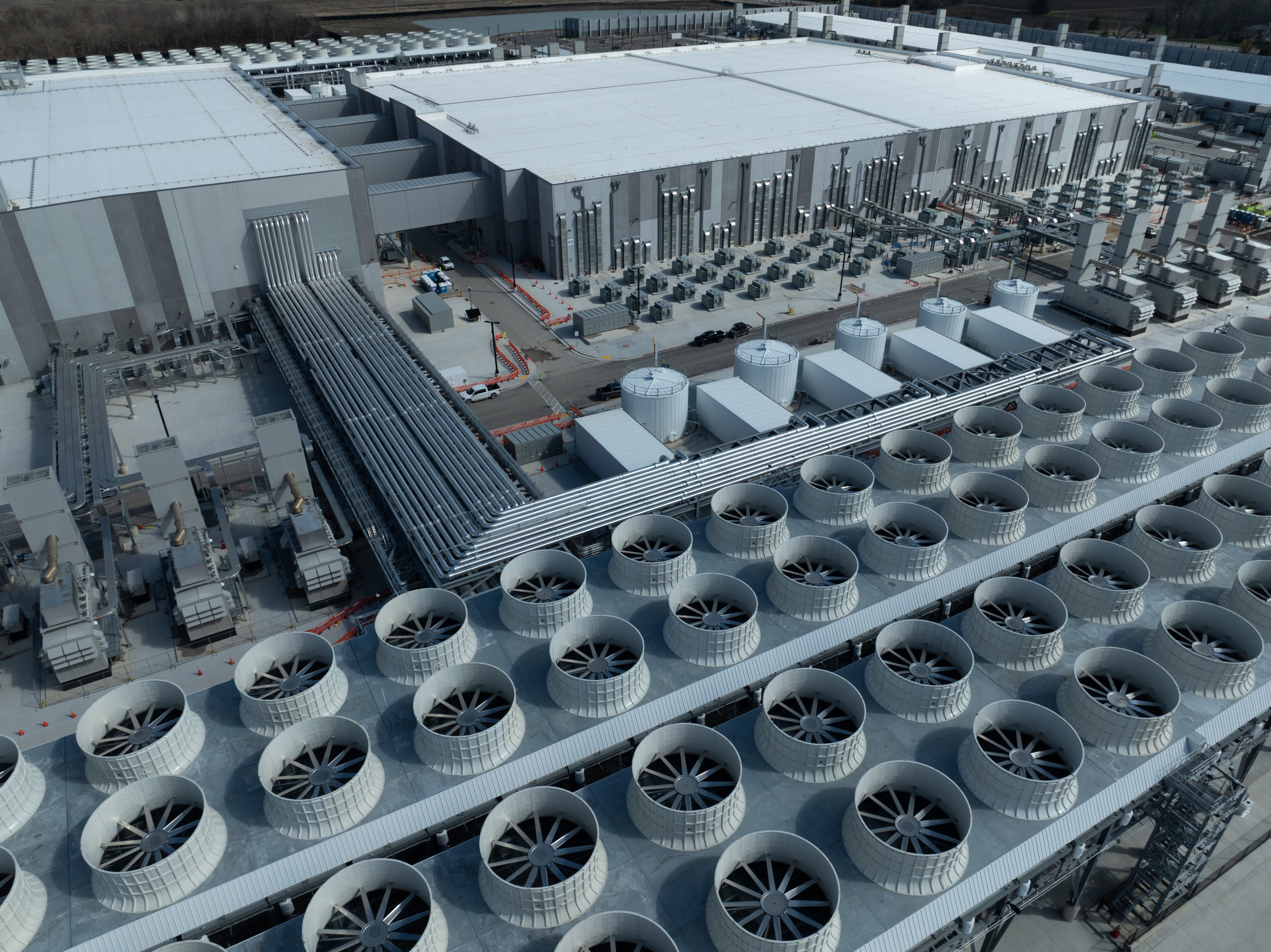
It is a large building full of computing resources and then the electricity and cooling components that keep it all from melting.
We often think of it using the marketing term “the cloud.”
The cloud is really just a data center in a building in a county that you’ve never driven through, but that pays property tax and has some sort of political constituency.
Jessica Stern
Why do people hate these things?
[Laughs]
David Adams
I was reading The New York Times earlier this year, and I don’t remember if it was on the editorial page or in an article, but they said it was the most bipartisan issue since beer.
Everybody likes beer, and everybody likes to hate data centers.
It doesn’t really matter what your political preference is.
I think there are a number of different reasons.
When it was just your phone doing something really cool and you thought, “That’s so neat. I just manipulated this photo,” or, “I got this new app and it works great,” that was happening in a data center somewhere.
That’s cool.
Once you connect AI to the data center, it can become the villain. It becomes something people start hating because it’s equated with perhaps the loss of jobs, giving up some of our intellectual property or something else.
I think that’s where it crosses the line for some members of the public.
The other thing is that data centers produce a lot of heat, and reducing that heat is not only technological, it’s political.
The politics around data centers often revolve around the resources used for them.
We think data centers, we think technology, we think computers. We think about them melting and needing to be cooled.
The real inputs to data centers are water, air, electricity and fiber — high-speed internet connections.
Where they are placed often follows where that infrastructure is.
How much they draw on the community’s source of water, how much they impact air and heat — that really determines the politics around data centers.
Jessica Stern
Who decides where a data center goes?
David Adams
There are a few different ways to think about it.
They’re kind of like the grain elevators and rail depots of the 19th century in the sense that those things followed where the people went.
Data centers follow where the electricity and fiber are.
Whatever internet connections are available or wherever electricity is plentiful, the economic geography of that place is going to be changed and ready for a data center to be sited there.
Jessica Stern
So it can’t happen anywhere. It has to have this confluence of infrastructure already in place.
David Adams
That’s right.
Jessica Stern
Let’s say I’m Meta and I want to build a data center.
Am I going to the city? Who gets to agree to having a data center there?
David Adams
That’s where it gets really contested and, I think, where it gets most interesting.
I just traced a case in Tucson, Arizona, of a data center that was trying to move into a particular area.
It was being contracted through a couple of different entities interacting with the government there.
The corporation went to the county to see if it could get land and spent a couple of years working with the county to purchase land to site a roughly 190-acre data center.
The county eventually said okay.
Then the public goes to the city because the city needed to annex the area to be able to provide water to the data center.
The city began to have zoning hearings and other conversations about whether it should annex where this data center was going and provide water to it.
That was rejected.
Jessica Stern
By the city?
David Adams
By the city.
The public said, “No, we don’t want this here. It’s the Sonoran Desert. Don’t take our water. Don’t site the data center.”
A lot of the public who had gone to the city thought the fight was over once the city said no.
The company building the data center said, “Okay, well, we won’t use water. We’ll air-cool it.”
Then they go to the Arizona Corporation Commission, which oversees the provision of electricity, and they say, “Sure, if it’s air-cooled, we’ll give you a connection to the Tucson power grid. You can plug in and build your data center.”
A few weeks ago, they started breaking ground on the data center, and the public is standing there at the fence saying, “We said no. We said no,” while they’re digging and the backhoes and fences are going up.
The public in many cases is going to where people are discussing it — where they think the decisions are being made.
In this case, that was city hall.
Where the real decision was being made was, one, at the county and, two, at the Arizona state commission that probably nobody in Tucson could even name the members of.
I think this is the case in many places.
The decision is being made at one level of government, and the public is fighting it at a different level.
Jessica Stern
How does the public know?
I’m a citizen. I heard there’s a data center. What’s my best bet to figure out where the decisions are being made?
David Adams
It’s a crapshoot.
Depending on the state, there could be seven different jurisdictions over one spot of land.
It could be a water district, an air district, the county, the city or the state.
Where to argue for or against it may depend on the site.
What we would call this in public administration and public policy is venue shopping.
You go to one venue, say the city, and if you don’t get what you want, you go to another venue.
The hard part is that the average person doesn’t have time to go to one hearing, then another hearing and then organize the protest to show up to a third hearing.
It’s easy to go to the one place where you can find access readily, but that’s often where the mismatch occurs.
Jessica Stern
This isn’t just that Tucson has a lot of different agencies. This is the norm? This is what we would expect in California?
David Adams
Yes, this is the norm.
These multinational companies are going to look for a jurisdiction with fewer barriers and where it is easier for them to site their data center.
The cost, though, may be pushed off to another jurisdiction or entity.
Virginia is packed full of data centers. Some counties in Virginia have more data centers than almost anywhere in the country.
When you connect a data center to the power grid and it uses more power, there can be implications for electricity rates and public infrastructure.
That creates a situation where the benefits and costs can become out of sync.
Jessica Stern
Is this another place where this feels like a United States story?
We talked about regulation in the EU. Do you know about data-center regulation there, too?
David Adams
I don’t know as much about that.
I do know that in the United States, there tends to be a more free-market approach.
In the European Union, there can be stricter controls around air pollution, water usage and heat.
Again, the approach is more about making sure something is not going to have a harmful impact on the public.
Here, it tends to be more, “Put it where you can, and then deal with the harm after the fact.”
Jessica Stern
Data centers, as you mentioned, have existed for a long time.
I like the point you made that they’ve kind of become this physical place where we can put all these anxieties about AI.
From your perspective and your specialty, does this feel like a new question, or have we seen other types of physical infrastructure raise these same questions?
You mentioned grain elevators. I’m thinking railroads. Where else have we seen this in history?
David Adams
My discipline might often turn to whether this is an equity question.
Are we locating them in places where the population can’t say no, in a sense, and where the institutional rules aren’t in place to prevent it?
There are instances, like where prisons are sited, where these often go into poorer or more disadvantaged communities.
In the case of data centers, that’s not always the case.
They can go into affluent communities. They go into suburban America. They go where the fiber is.
It kind of turns that equity-location model on its head.
The weird thing is with rural areas and really small towns.
If they locate in small towns, the sign can flip. You have lower income, and rural areas may be places where they accept the contract from the corporation building the data center, while richer, more affluent areas in the suburbs may be better positioned to negotiate the terms.
I think that is where there could be a difference between the two.
Jessica Stern
I was at an American Indian Chamber of Commerce meeting, and somebody who works with tribal governments said he wished his home community would build a data center and reap the revenue because they have so much land away from populations.
But what you’re saying is interesting. You really need places that already have enough fiber optics to sustain that.
You can’t just put these anywhere.
David Adams
No.
Typically, you might think these things would be sited in the middle of nowhere — and maybe that is more ecologically sound, depending on the location.
But that’s often not where the fiber connections are.
Jessica Stern
Why are some cities and counties saying yes to data centers? What are the potential benefits?
David Adams
I think the largest benefit that would attract a city is the tax base.
It’s tax base without people.
Normally, if you put in a large new factory or plant, you’re going to hire a whole lot of people. Those people are going to move to your jurisdiction.
Now you need more schools. You need improved roads. You need apartment complexes and new neighborhoods.
With a data center, construction crews come in and you may have a short-term population explosion. But after a few years, the long-term staffing can be relatively small compared with the scale of the facility.
You have this large tax benefit — this company producing a lot of revenue going into your tax coffers — and you don’t have the same long-term population growth and strain on systems.
Jessica Stern
That sounds good.
David Adams
In a real sense, yeah.
The immediate problem, though, is when they end up siting in a rural area.
There are places where thousands of construction workers and their families may come into an area temporarily.
They have demands on police, fire, school systems, hospitals and roads, and then they’re all going to go away.
There’s a long-term benefit of the tax base, but there’s an immediate crunch of, “We have a whole lot of people we have to serve right now.”
This isn’t new.
It happened in North Dakota and other states where people would come into an oil field and extract oil through fracking. Many people would come into the area for a short period of time, and then the oil activity would decline and they would move on to the next place.
A similar dynamic can happen here.
Jessica Stern
I’ve heard one theory that part of what’s happening is distrust of these companies — communities not trusting that they’ll be there for the long haul.
David Adams
Yeah.
There’s the stranded asset worry.
If you take over 200 acres of land and build this giant warehouse, what happens when the technology evolves?
What happens when it’s not needed anymore?
Now the community is stuck with this giant building — this stranded asset — with all the infrastructure left over.
Who’s going to clean that up? Does that bill go to the state? Does that bill go to the community?
Is there a giant plot of land that could have been something else and now it’s an abandoned building?
I think that’s a real concern.
Jessica Stern
What do we know about the specifics of why people are opposed to data centers?
David Adams
In Tucson, the public actually did go to hearings about their opposition to or support for data centers.
Tucson reached out and had a number of different ways for public comment to occur.
People could come into meetings where their comments were put on large whiteboards. They had Zoom meetings. They accepted email comments.
This was all about developing a city code for future data centers — not the one being built right now, but ones that may come after it.
The big number was that the public was overwhelmingly opposed.
But the more detailed finding in that data set is that a substantial share were opposed because they wanted more regulation.
If there were more regulation, they might not necessarily be opposed.
That could mean regulation around water, air quality, noise — they’re really loud — or how far the facility is set back from the road so people don’t have to look at it.
Another portion were opposed because they didn’t like the process. They didn’t feel the process was legitimate.
It may have been legal, but they didn’t think the way the city was asking questions or courting potential data centers was legitimate.
If we just say, “Everybody is opposed,” it’s more nuanced when you look at what they were actually opposed to.
It’s not necessarily data centers broadly. It’s also about how the government is going about doing it.
Jessica Stern
In this void of having a decision set, it seems like an exciting opportunity for a city to decide how they’re going to court public opinion and how they’re going to come up with these decisions.
Have you seen examples of how cities are making these decisions?
David Adams
Absolutely.
I’ll go back to the data I’ve been working with from Tucson.
The city offered several different ways for the public to comment on a potential data-center law they were developing and on how that process was going to occur.
To overcome some of the negative politics around it, the city did community engagement.
They opened forums where the public could come in, talk with members of the city council and representatives about what a data-center policy might look like.
They did it workshop-style with a big whiteboard and took down the ideas the public was thinking about.
That was one channel.
They also opened a Zoom meeting channel where the public could interact with them.
A lot of those comments were about the process or about the kinds of regulations people wanted.
They also opened it up for email comments.
The email comments were really nuanced, detailed and policy-oriented.
It showed that when the public wants to engage, it can do so at a number of different levels — from attending something and offering one or two comments to sitting down and writing a long-form email outlining what they would prefer to see in a policy.
Jessica Stern
Are you currently doing research on public policy and AI? And if so, what?
David Adams
Yeah, in a couple of different ways.
I’ve already written and published on algorithmic governance, looking at the use of blockchain and AI in decision-making.
Currently, I’m writing about data centers.
One paper is using what’s called the Narrative Policy Framework, which identifies policy narratives much like you would any other narrative: There’s a storyline, a plot, a hero and a villain.
In Tucson, they made a lot of their public comments about potential data-center policies or laws available on their website.
I found transcripts of public comments, whether they were given through long-form email or in a public forum workshop, and coded each one around what the potential opposition was to the data center, where people were associating blame, whether they thought something was a hero bringing jobs to the community, a villain or whether AI itself became the villain.
The data was at two points in time around this large debate, so I was able to watch the narrative change from time A to time B and see who was framed as the hero and who was framed as the villain over time.
Jessica Stern
I’m on the edge of my seat. Who was the hero and who was the villain?
[Laughs]
David Adams
The villain would certainly be AI in a sense — this potentially amorphous AI.
There was also concern about the impact on the environment, air quality, water quality and water quantity.
That’s kind of structured as the bad guy or the boogeyman around this.
Jessica Stern
Can we talk about water?
I have a 14-, almost 15-year-old daughter who hates AI, largely because of its environmental impact.
But then I was reading that the water impact isn’t necessarily that bad because some systems use a closed circuit, recirculating water over and over again.
She will not let it go.
What do you know about this? Help me settle this debate.
David Adams
Like everything, it depends on context — the location and the type of cooling system they have.
And for the record, my 10-year-old thinks AI kills polar bears.
[Laughs]
So we’re on the same page there.
A lot of data centers are situated in places with abundant water or where renewable power is available.
On the other hand, your daughter may be thinking about water used for cooling.
In a more traditional system, water can be pulled in, used to cool equipment and then put back out into the water system as heated water.
That heated water can be detrimental to the ecosystem.
Fish don’t like hot water. Algae blooms in hot water. All sorts of changes can occur within the water system because of heated water or whatever chemicals or other pollutants may be introduced.
That is how many systems were built early on — a throughput water process: pulling it in, cycling it through, cooling things off and putting it back out.
Now, many systems are drawing once and keeping that water within a closed circuit to continuously cool.
Jessica Stern
So my daughter and I are both right.
David Adams
You’re both right.
[Laughs]
Technology is changing.
Water is also used during the construction process. If you’re putting it in a water-starved area, there can still be significant water use involved in construction, making concrete and everything else.
But cooling technology is moving toward systems that don’t necessarily have to continuously use new water.
Electricity is a real issue.
Fiber is one component. Electricity is the other.
There are power companies with long queues of data centers waiting to connect to their systems.
Part of the siting decision is: Can I connect tomorrow, or can I connect next decade?
If they want to build a data center thinking they’re going to connect to the grid in five years, what many of them do is create power generation on-site so they can get it up and running.
As they continue to expand it, they eventually connect to the power grid.
When you say, “A data center is built in this place,” maybe one building is situated and being powered temporarily by on-site generation while you’re building many more pieces of the site.
By the time the whole site is built out years later, that may be when it can fully connect to the grid.
Jessica Stern
Could they push technological innovation to create better, cleaner ways to do things?
David Adams
Eventually, with all the computing power, AI and the ability to process information so quickly, we could potentially solve big questions.
We could solve medical mysteries. We could develop solutions to social problems that have plagued us for generations.
All of that takes computing power.
And all of that computing power takes data centers.
It’s processed by artificial intelligence models that continue to advance and grow.
Jessica Stern
For students who want to learn more about AI and public policy, where should they go?
David Adams
I’m working on that right now.
I developed a new class over the summer called AI Policy and Governance, and I’m hoping it goes live in 2028.
It’s going to be an AI class with no programming.
It’s designed for the Computer Science AI major, but it’s structured as a GE class so students across campus who are interested in any of the topics we’ve talked about can take it.
They’ll be able to understand more about how the United States approaches AI and artificial-intelligence issues versus the EU, how we think about the ethics behind it, how AI is being used in government decision-making and the policies that are evolving over time.
Jessica Stern
Wonderful.
Dr. Adams, thank you so much for helping us understand AI regulation, data centers and the decisions that citizens, counties, cities and agencies make.
We can’t wait to read your future research.
David Adams
Thank you so much. It’s been a pleasure.


 Are we taking the human out of the equation? And what happens when the infrastructure powering AI starts competing for the same resources our communities rely on? These are some of the questions at the center of this episode of Lowkey Confused? HSS Explains! Dean Jessica Stern sits down with Dr. David Adams, professor of public administration at Cal State Fullerton, whose research examines how institutions adapt to environmental, political, and technological change.